Foundation repair
Wall Bracing for Bowing Foundation Walls in the North Metro
Bowing, bulging, or leaning basement walls are a structural warning sign. A local contractor installs steel or carbon-fiber bracing to stabilize the wall and stop inward movement before it becomes a major repair.
What wall bracing is and when you need it
A bowing basement wall is one of the most serious warning signs a north metro homeowner can find — and one of the most important to catch early. When a foundation wall starts pushing inward, bulging, or leaning, it means the soil and water pressure outside has overwhelmed the wall's ability to hold. Left alone, that inward movement doesn't stop. It accelerates, especially through our freeze-thaw cycles, and a wall that could have been braced and stabilized turns into one that has to be excavated and rebuilt. That's the difference between a repair and a project.
The cause is almost always the same combination: heavy clay soil that expands when it's wet, poor surface drainage or downspouts dumping water right against the foundation, frost heave pushing against the wall, and the lack of a working footing drain to relieve the pressure. In homes built from the 1960s through the 1980s — common across Coon Rapids, Fridley, Columbia Heights, and Brooklyn Park — block walls are especially prone, because the horizontal mortar joints give the wall a weak line that bows inward under sustained pressure. Poured concrete walls bow too, often with a noticeable horizontal crack that lines up with the frost line.
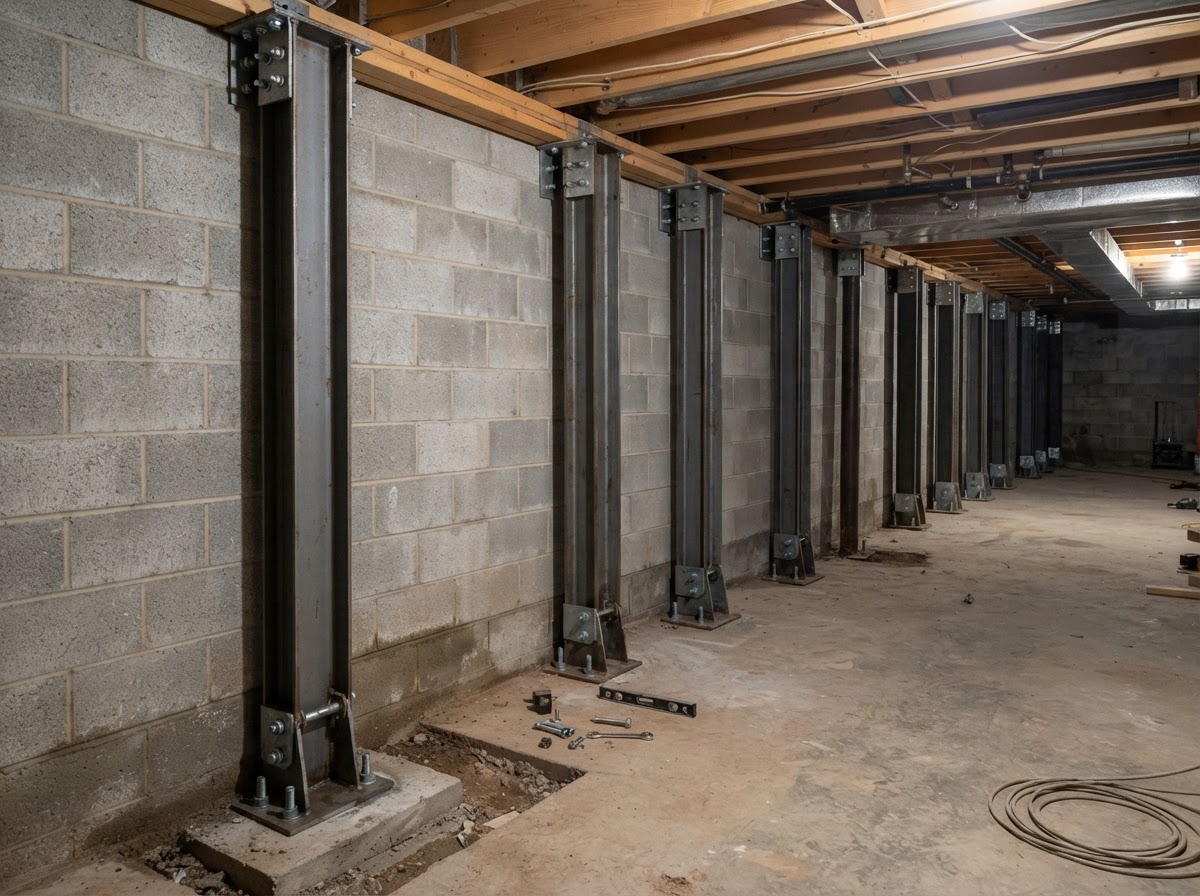
Wall bracing stabilizes the wall and stops further inward movement. The two main approaches are steel I-beam bracing and carbon-fiber reinforcement. Steel beams are bolted to the floor and the framing above, spanning the full height of the wall at intervals, and they lock the wall in its current position so it can't move further. Carbon-fiber straps are bonded directly to the wall surface and are lower-profile, good for walls with modest movement where you want to avoid losing floor space to a beam. Which one fits depends on how far the wall has moved, whether it's still progressing, and the wall's construction. A contractor will measure the deflection, look for cracking patterns, and recommend the right approach — or, if the wall has moved too far, tell you honestly that bracing alone isn't enough and more involved reinforcement is the call.
It's worth being clear about what bracing does and doesn't do. Bracing is a stabilization, not a straightening. In most cases the goal is to stop the movement permanently so the wall is safe and the problem doesn't get worse. Some systems can pull a wall back toward plumb, but that's a bigger job with excavation. What bracing absolutely does is buy you time and certainty — turning a wall that's slowly failing into one that's secure — and it's almost always far less expensive and less disruptive than waiting until the wall needs to be rebuilt.
The other half of the fix is usually addressing the water. If you brace a wall but leave the drainage problems that caused the pressure, you haven't solved it for the long run. A good contractor looks at the whole picture: the wall, the downspouts, the grading, and whether the home needs drain tile or sump work to relieve the pressure for good. After your free inspection, you'll know what's actually going on, what it takes to stabilize the wall, and what it takes to keep it from happening again.
What this includes
- Stabilizes bowing block and poured walls
- Stops inward movement before it worsens
- Less invasive than full wall replacement
FAQ
Wall Bracing questions, answered
How do I know if my wall is bowing?
Signs include a wall that's visibly pushed inward at the middle, horizontal cracking (often near the frost line), stair-step cracking in block walls, a wall that's out of plumb, or doors and windows in the basement that stick or won't close. If you see any of these, get a free inspection — measuring the movement early is what keeps bracing on the table.
Will wall bracing straighten my wall?
Bracing primarily stabilizes the wall and stops further inward movement; it usually doesn't fully straighten a wall that's already bowed. Some systems can pull a wall partway back, but that's more involved. The goal is to stop the movement and make the wall safe and permanent, which is almost always far less disruptive than waiting until it needs to be rebuilt.
Steel beams or carbon fiber — which do I need?
It depends on how far the wall has moved and the construction. Steel I-beams are stronger and handle larger deflections; carbon-fiber straps are lower-profile and suited to walls with more modest movement. A contractor measures the deflection and recommends the right system — or tells you honestly if the wall has moved too far for bracing alone.
How much does wall bracing cost?
Cost depends on the number of walls, the bracing system, the spacing of the supports, and whether drainage work is needed to address the cause. A local contractor gives you a clear, itemized quote after your free inspection so you understand both the stabilization and what's driving the pressure.
Ready for your free inspection?
A local contractor will come out, look at the problem, and give you a straight, no-pressure quote. The sooner it's caught, the smaller the fix.